

In a recent AASA webinar, Caitlin Richard, former CFO of Hartford Public Schools, joined Timely’s Jake Lessem and Dave Bosch to talk through how the district used its schedule to work through a $60 million structural deficit and why Hartford decided their budget leaders belonged at the table.
Below are four lessons from that conversation for district finance and academic leaders.
>> Watch the full conversation on-demand.
1. Schedule special education first
In many districts, special education staffing is a siloed part of the master scheduling process. The special education team sends the number of staff it needs, and finance adds it to the budget. That number tends to rise each year, even as special education vacancies go unfilled. When special education is scheduled last, it often inherits whatever is left, and the same staffing requests roll forward year after year.
“I never really knew what questions to ask, and so we would take [their requests] and add it to the budget.”—Caitlin Richard, Former CFO, Hartford Public Schools
Hartford worked with Timely to flip this order: the district’s special education leaders got access to school schedules early, so they could discuss support models before the rest of the schedule was built. Prioritizing the special education assignments puts students’ needs first, manages the complexity of assignments, and helps a district use the special education teachers it already has more efficiently.

2. Give schools and finance the same staffing number
A formula-based allocation tells a school how many teachers it will get, but it doesn’t answer whether the school can meet student needs with that number. At Hartford, the central office had two figures for each school: current staffing and next year’s allocation, set by a 21-to-1 student-teacher ratio. When enrollment declined and allocations dropped, principals pushed back, but finance had no way to tell whether those cuts would hurt students.
The missing piece was a third number: the minimum FTE each school needs to run its schedule, based on enrollment, periods offered, teaching load, and sections required.
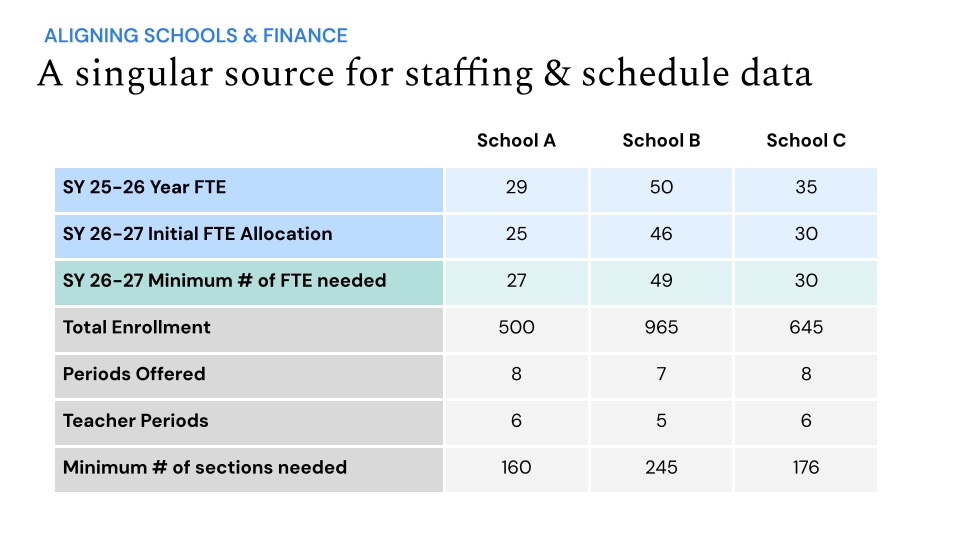
With that number on the table, the conversation changed. If School A has 29 teachers and the formula said 25, but its schedule required 27 to fulfill student requirements, finance and the principal were now able to work together to find additional allocations.
“It shifted conversations from tension and uncertainty to clarity on what was needed. And then we could work on how we get there.”—Caitlin Richard
💡 To run a similar analysis for your own schools, start with Timely’s Staff Planning Toolkit.
3. Plan reductions around attrition and reassignment
When a district knows how many teachers each schedule requires, it can plan reductions well ahead of hiring season and match them to the positions that will open up on their own. Hartford reduced teaching allocations by 20 FTEs across 11 high schools, saving about $2 million. Every teacher who wanted a teaching job the following year had one; the reductions came entirely through attrition and reassignment. And because each reduction was based on what the schedule actually needed, Hartford made the cuts without harming the student experience.

4. Use scheduling data to make the case for funding
In this budget conscious environment, increased credibility can be as important an outcome as immediate savings. The district could show principals, city leaders, and state legislators that it was using its resources carefully, and exactly where further cuts would affect students. That data became the foundation of a legislative case that won Hartford $90 million in incremental state and city aid over two years.
For more information on Hartford’s story, read the full Hartford Public Schools case study.
Where to start: look at the schedule
Asked what she would tell district leaders facing budget pressure, Caitlin pointed to the master schedule. It holds most of a school system’s resources, and it is one of the few places a district can find savings while improving what students experience.
“My advice is to look at the schedule if you’re having budget challenges because you might be surprised at what you will find there.”—Caitlin Richard

If you’re thinking about how your central office can support that work, The District’s Role in Strategic Master Scheduling covers four areas to address.
Watch the full conversation
The schedule is a budget tool, and Hartford shows what’s possible when finance and schools use it together. The full webinar goes further into how Hartford scheduled incoming ninth graders before they enrolled, how principals responded to the new process, and how Timely calculates each school’s staffing needs.