
overview
“We can’t ignore the fact our district has gotten smaller over the years. As a result,
we are carefully and proactively addressing this reality by adjusting in ways that are
respectful and supportive of our hard-working staff and, most of all, strengthens the
student experience. And that requires diving into scheduling and staffing.”
Rick Rodriguez Chief Operating Officer, Lubbock Independent School District
As Superintendent Kathy Rollo and the team at Lubbock Independent School District (LISD) prepared for the 2023-24 school year, they faced a host of complex challenges, shared by many districts around the country. The pandemic had taken its toll academically and emotionally, exacerbating achievement gaps. Enrollment has declined, falling approximately 9% in the last five years. And the financial pressure of that enrollment decline has been compounded by the ESSER fiscal cliff. The LISD team knew they needed to simultaneously ‘right-size’ the district while enabling investment in new programs to enhance academic outcomes and the student experience.
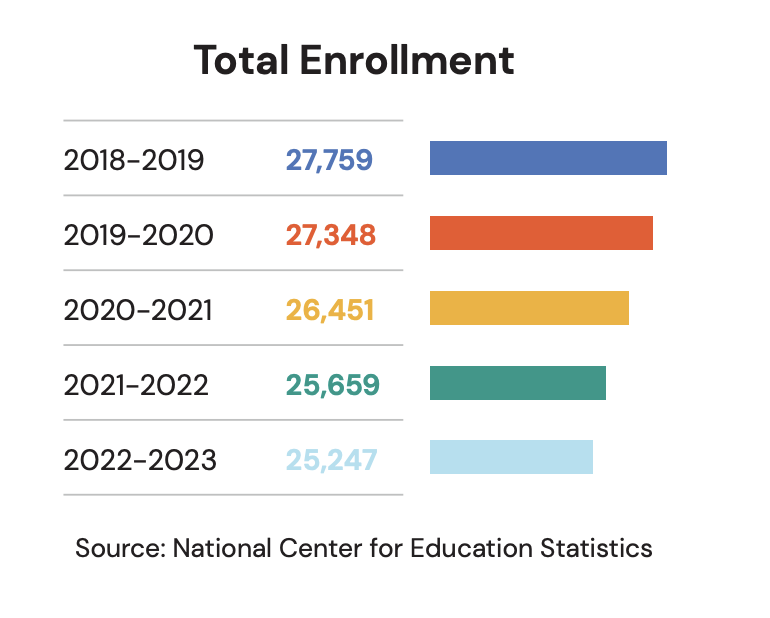
LISD took a unique approach to building these plans: they began working with Timely and utilized school scheduling as a vehicle to enable priorities for the 2023-24 school year. As a result, Lubbock was able to make significant progress towards its objectives:
- Address the need for improved middle school academic performance: the district invested in new double blocks of ELA and math which required hiring additional teachers.
- Increase capacity to better serve students with disabilities: this subgroup that has been steadily increasing even as overall enrollment has been decreasing: the district hired 18 more staff members across grades 6 to 12 and dedicated additional funding for professional development.
- Efficiently allocate resources across all schools to address budget pressures from declining enrollment: by scheduling more consistent class sizes and teacher loads, LISD reduced staffing by 37 positions across 9 middle schools and 5 high schools, representing ~$2.2 million of savings which were then reallocated to the above priorities. Critically, these savings were realized through attrition, and thus didn’t require layoffs or program cuts.
Altogether, scheduling uncovered misalignments and inefficiencies of over $2 million, which were then reallocated to critical new investments in middle school academics and supports for special populations to address the district’s evolving needs, centered on the urgency to enhance student learning. And the district took the first step of a multi-year plan to more efficiently allocate resources to schools given budget pressures while strengthening transparency and partnership between schools and the central office.
The Solution
How Lubbock Unlocked Resources
Step One: Assess, align on goals, and initiate a planning process with school leadership
Lubbock’s district leadership, led by Misty Rieber, Chief Academic Officer, Rick Rodriguez, Chief Operating Officer, and Max Flores, Executive Director of Human Resources, articulated district wide goals, which included:
- Improve academic outcomes across the district’s nine middle schools
- Increase capacity to better serve students with disabilities, driven in part by referrals from nearby, rural districts
- Efficiently allocate resources to align to the realities of declining enrollment
For the second consecutive year, the district maintained an overall average class size target of 24, a figure still below the Texas state average. But initial analysis reflected significant variation of class sizes and teacher loads across schools, and often within individual schools driven by inefficient staffing and scheduling, an unintentional reality. What’s more, the smaller classes were not generally found in priority areas – schools, subjects, and students in need of additional support; instead, they were in areas where staffing levels simply weren’t adjusted to match enrollment.
District leadership then established a regular meeting cadence with school leaders – principals, assistant principals, and counselors, including directors of athletics, career and technical education, and fine arts when relevant. These meetings centered around student needs, course requests (for middle and high school students) and the commensurate allocation of staff.
Step Two: Analyze trade-offs and make deliberate choices to meet goals
The district team then took a careful look at every teacher’s teaching load, as well as class sizes by school, subject and grade. This visibility created an important degree of transparency amongst all parties, allowing school-based staff to understand how and why decisions were ultimately made to address district priorities.
During this step in the process, the Lubbock district team and school-based staff assessed benefits and trade-offs of various scenarios to enable their goals. For instance, in order to elevate middle school performance, the district team assessed a number of options, such as increasing planning time for ELA and math teachers in addition to lower group sizes and increasing the number of periods teachers teach relative to the number of periods students have.
Step Three: Finalize staffing allocation and build schedules
Once staffing allocations were confirmed, school leaders built their schedules and loaded students into classes. As one Lubbock school leader reported, “The real-time feedback with numbers and class sizes… allowed us to make data-informed decisions” which led to significantly more students getting full schedules than in previous years, reducing the time consuming task of handscheduling, and requiring fewer adjustments to staffing plans and student course requests.
“We aren’t sitting here in August trying to hand-schedule kids,” said one school leader. Another noted, “Having this process really helped to take a ton of stress and anxiety off of our team.”
the IMpact
Ultimately, Lubbock’s scheduling process moved the district closer to its overall average class size target by addressing the unintentional variation of class sizes and teacher loads, which unlocked significant resources to enable the district’s key priorities:
- To address the need to improve middle school academic achievement, Lubbock invested in double-blocks of ELA and math across all nine middle schools which required hiring additional teachers due to a higher number of periods teachers teach relative to the number of periods students take.
- To address an increasing population of students with disabilities, Lubbock dedicated additional funding and resources to hire more special education teachers and increase professional learning.
- To address budget pressures, Lubbock took a critical, first step by identifying significant savings which (a) allowed for investments in the academic and staffing priorities noted above, (b) mitigated a reliance on the district’s reserves for one-time funds to plug recurring expenses, (c) avoided the need for teacher layoffs, and (d) established the foundation for a multi-year process of flexing resources to address changes in enrollment and resources needed to best serve its student population which has been in decline.
As described earlier, their initial analysis reflected significant variation in class size and teacher load across schools in the district, and, in many cases, across teachers within the same school and even department. By moving towards more consistent class sizes and teacher loads, schools and district staff identified 37 teaching positions across the district’s 9 middle and 5 high schools that could be reduced for the 23-24 school year – a savings of over $2 million, without having to increase overall class size targets or cut in-demand programs. This reduction in staffing was achieved almost entirely through attrition or, in limited cases, staff reassignment across schools, avoiding the need for layoffs that might have been required without a strategic approach to staffing
The expansion of double-blocks of ELA and math across all nine middle schools led to an additional allocation of ELA and math teachers, amounting to nearly a $1 million investment of resources into core instruction. Also, additional special education staff were allocated to better serve LISD’s increasing population of students with disabilities, in response to input from school-based staff about the need for additional support to serve their students well.
conclusion
Through the use of scheduling – a process that is rarely used to enable strategic planning – the Lubbock Independent School District achieved $2.2 million of savings across a total of 14 schools which was re-allocated to its academic and staffing priorities in middle school ELA and math and special education staffing across all schools.
Perhaps most importantly, LISD will be able to build on this progress by enhancing their timelines, systems, processes, and tools so that the annual scheduling process will be an ongoing opportunity to ensure efficient and strategic use of resources.
Critically, had LISD not undertaken this initiative to find budget efficiencies and use scheduling as a lever to drive strategic planning, the district would have faced unwelcome alternatives such as an across-the-board reduction-in-force or, if unable to balance their budget, a potential review by the Texas Education Agency.
This report aims to showcase the adroit leadership of Lubbock Independent School District and sheds light on the importance of scheduling as a vehicle to align resources to the needs of students. Lubbock is hardly alone in the challenges it has inherited: many districts and charter management organizations nationwide are facing some combination of decades-old achievement gaps, pandemic-related learning loss, declining enrollment, and expiration of ESSER funds.